

War … What is it Good For?
By: Aaron Anderson, CFP®, CFA, Managing Partner
March 3, 2026
As I write this, the market is down about 1.5% today. Yesterday, on news of the war[1] over the weekend between the US/Israel and Iran, the market opened down (not surprising) but then ended up closing higher than the close on Friday – before any attacks had happened. This is somewhat surprising although one can say in hindsight that the market expected it would happen due to the positioning of US military assets in the Middle East.
Before starting, I just want to mention that this article is in no way meant to minimize the awfulness of the war on both sides. The loss of life and property is tragic. Our thoughts and prayers are with our soldiers as well as the people in the Middle East.
Iran has little, if any, direct role in investment portfolios because of years of heavy sanctions. Their economy has been experiencing hyperinflation with their currency collapsing. Indirectly, they are an oil-producing member of OPEC and control the Strait of Hormuz which leads to the Persian Gulf. As such, oil prices have increased and shipping through the area has been disrupted. Despite not being a large part of any portfolio, reasons such as these tend to put a scare into the market and cause volatility.
Since we never know what the future will hold with certainty, we recognize that in general, there is nothing new under the sun. So, we can use history to help guide our expectations.
Fortunately, history has shown that the markets are resilient after geopolitical events. For example, this chart shows different events from the 2000s and the market reaction within the first year.
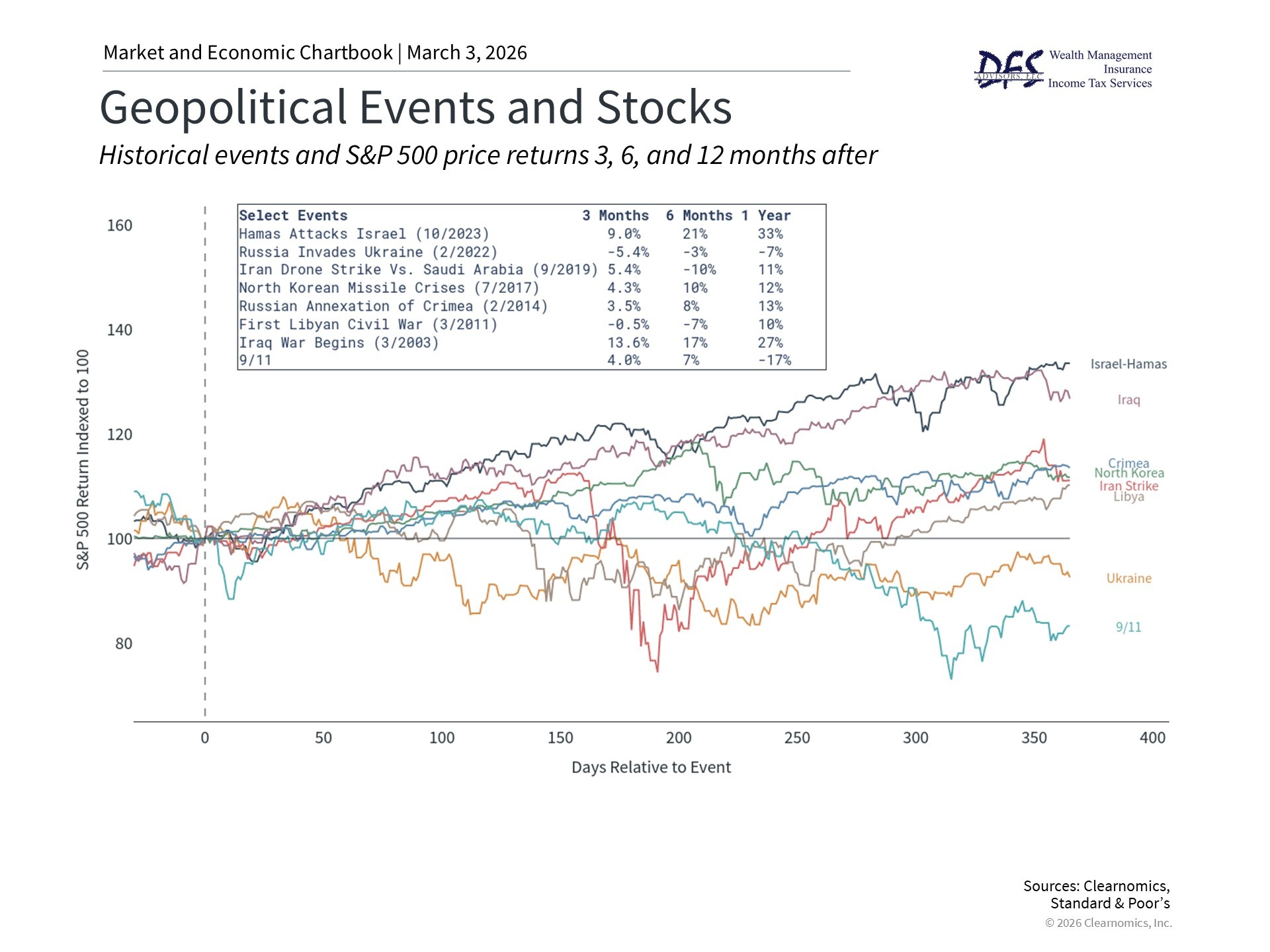
Most of the time, the market was up one year later just a little above average - a few times substantially so. After the Ukraine invasion, the market was down 7%, but that was 2022 after a very good 2020 and 2021, so it’s hard to pin that on the invasion. Similarly, it was down 17% after 9/11, but the market was already in the doldrums of the “dot com crash” that occurred earlier in the year. This also occurred after a very good late 90s era.
Of course, we are generally not one-year investors. We invest for the long haul. So, this chart shows different wars over the last century and stretches the return numbers out to a 10-year timeframe.
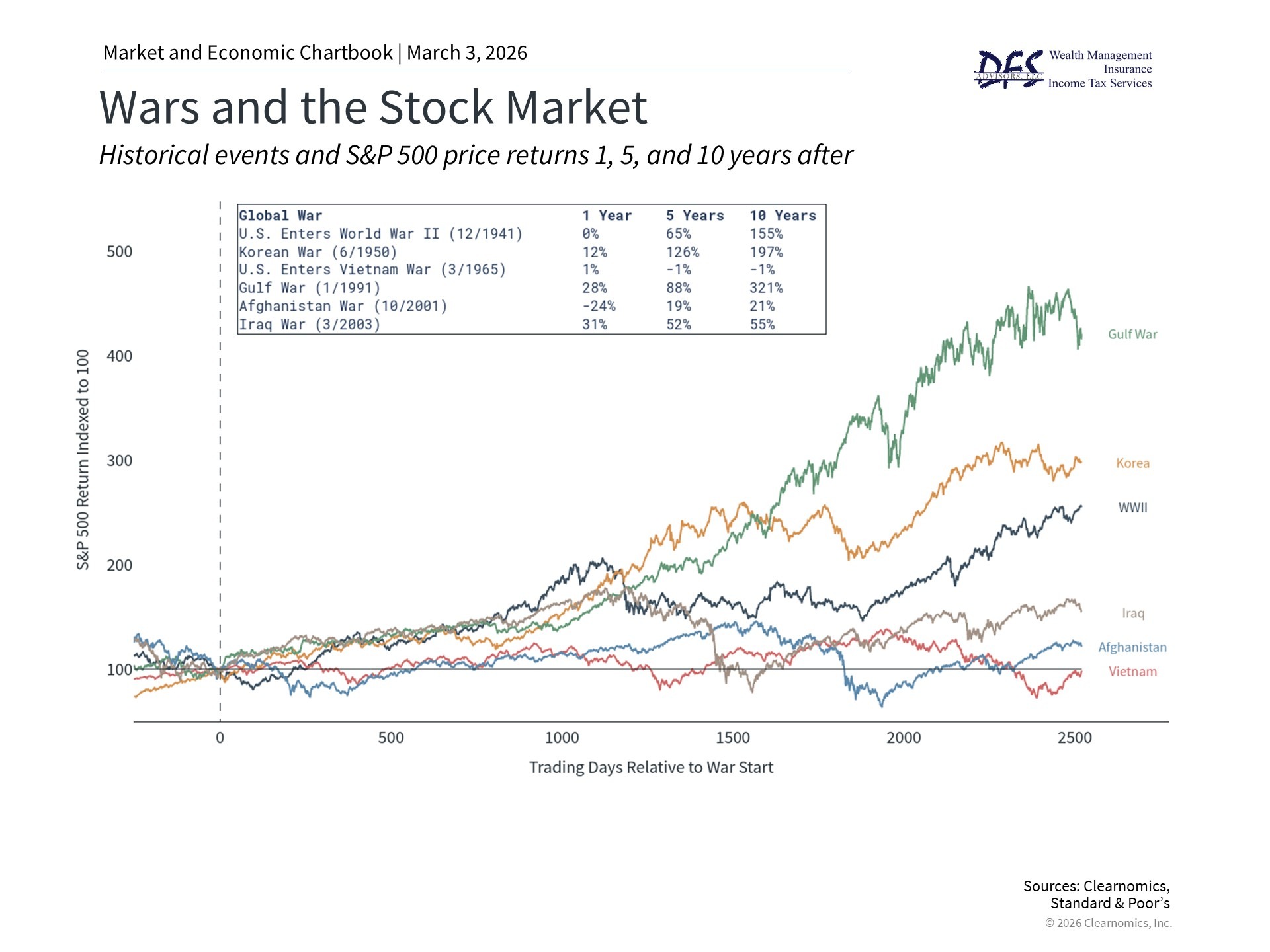
The only one that was negative after 10 years was Vietnam, but that 10-year period also had two recessions, one of which occurred right at the end of the timeframe, and the Federal Reserve was trying to control inflation that was rampant in the 1970s.
The other two with positive but poor performance were Iraq and Afghanistan, both of which had the Great Financial Crisis of 2008 during the 10-year period. The market didn’t perform as well during those years, but it likely wasn’t because of the wars.
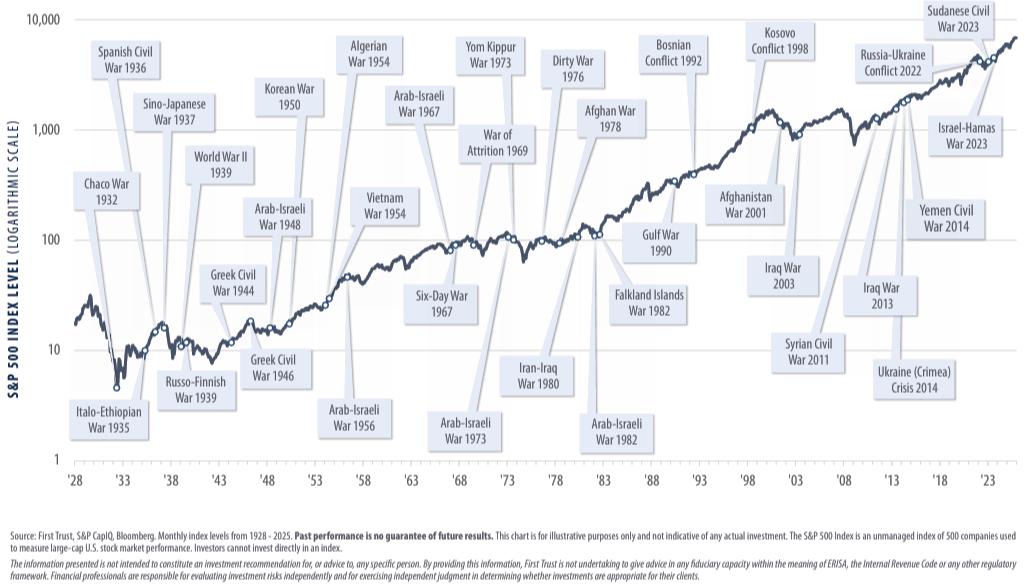
The market always has reasons to sell off, a lot of them based around wars and other geopolitical upheaval. Volatility around the event is expected. Despite all of the reasons to be fearful though, the market has been resilient for those willing to stay focused on the long term.
[1] Technically Congress enacts wars and this is a military operation, but I’ll use the term “war” for simplicity.
Content in this material is for informational purposes only and not intended to provide specific advice for recommendations for any individual. All performance referenced is historical and is no guarantee future results. All indices are unmanaged and may not be invested into directly.
The Standard & Poor's 500 Index is a capitalization weighed index of 500 stocks designed to measure performance of the broad domestic economy through changes in the aggregate market value of 500 stocks representing all major industries. The NASDAQ Composite Index measures all NASDAQ domestic and non-U.S. based common stocks listed on The NASDAQ Stock Market.
The economic forecasts set forth may not develop as predicted and there can be no guarantee that strategies promoted will be successful.
Stock investing includes risks, including fluctuating prices and loss of principal.